










Introduction
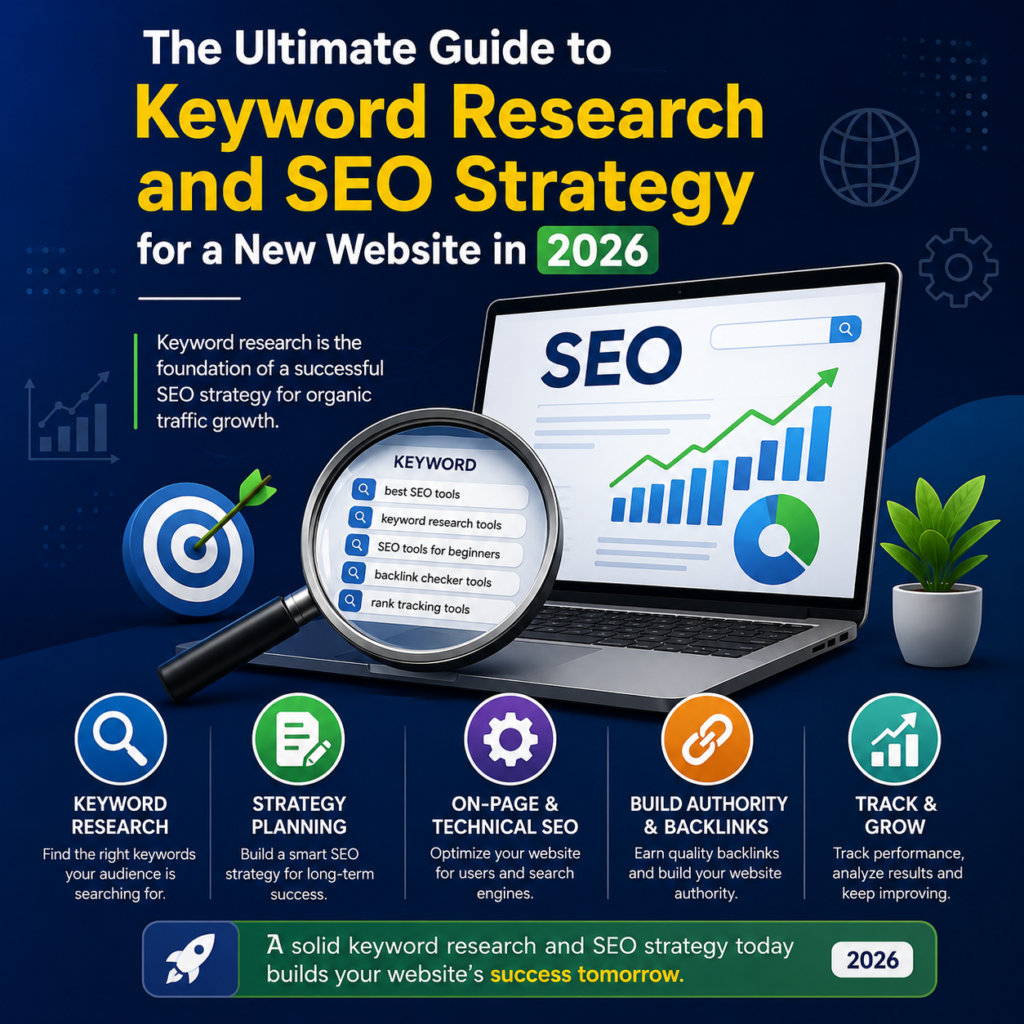
Starting a new website in 2026 is exciting, but it is also highly competitive. Every business wants traffic, leads, customers, and visibility on Google. But simply publishing a website is not enough. If you want people to find your website through search engines, you need two things from the beginning: proper keyword research and a complete SEO strategy.
Keyword research helps you understand what your audience is searching for. It shows you the exact words, questions, problems, and topics people use when they look for information, products, or services online. Without keyword research, you may create content nobody is searching for, target keywords that are too competitive, or attract visitors who are not interested in your offer.
SEO strategy gives direction to your website. It helps you decide what pages to create, how to structure your content, how to optimize your website, how to build authority, and how to track results. A strong SEO strategy is not only about ranking one blog post. It is about building a website that can grow organic traffic consistently over time.
For a new website, SEO should start before you publish dozens of pages. You need to understand your niche, research your audience, map keywords to pages, create helpful content, optimize your technical foundation, and build trust step by step.
In this guide, you will learn how to do keyword research and build a complete SEO strategy for a new website in 2026. This article is written in a practical way, so you can use it as a roadmap for launching and growing your website.
Why Keyword Research Is the Foundation of SEO
Keyword research is the starting point of every successful SEO campaign. It helps you understand your market before you start writing content or building pages.
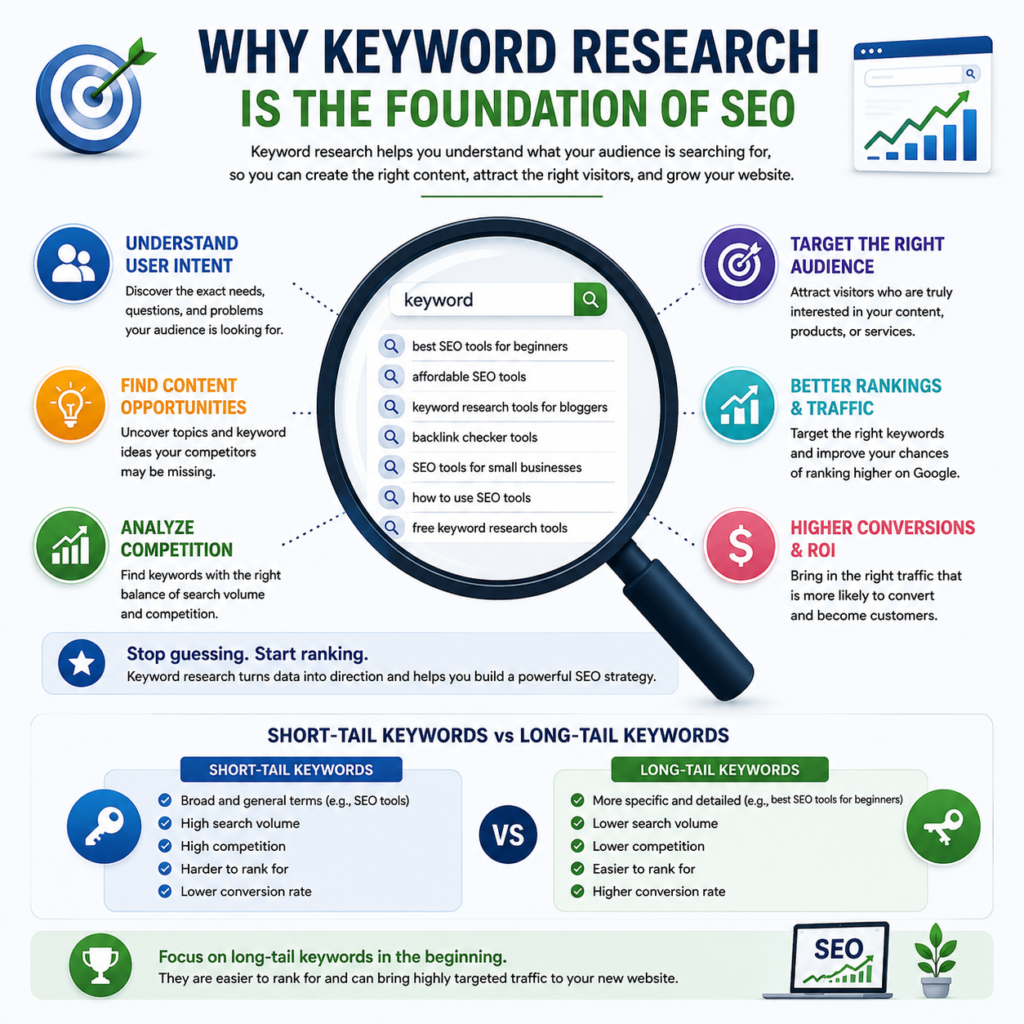
Many beginners think SEO is only about adding keywords to a page. But keyword research is much deeper than that. It helps you understand user intent, competition, content opportunities, and the best way to structure your website.
For example, if you are building a website about SEO tools Seotoolsgroupbuy.us and you may think your main keyword should be “SEO tools.” But this keyword is broad and competitive. A new website may struggle to rank for it quickly.
Through keyword research, you may discover easier and more specific keyword opportunities such as:
- best SEO tools for beginners
- affordable SEO tools
- keyword research tools for bloggers
- backlink checker tools
- SEO tools for small businesses
- how to use SEO tools for keyword research
- free keyword research tools
These long-tail keywords may have lower search volume, but they are often easier to rank for and more targeted. For a new website, this is very important.
Keyword research helps you avoid guessing. Instead of creating content based on what you think people want, you create content based on what people are actually searching for.
Why a New Website Needs a Complete SEO Strategy
A new website has no authority, no established rankings, and usually no strong backlink profile. That means you cannot depend on random content publishing. You need a proper plan.
A complete SEO strategy helps you answer important questions:
- Who is your target audience?
- What problems are they searching for?
- Which keywords should you target first?
- What pages should your website include?
- What blog topics should you publish?
- How should your internal links be structured?
- What technical SEO setup is required?
- How will you build backlinks and authority?
- How will you track rankings and traffic?
Without a strategy, your website may become messy. You may publish many articles that do not connect with each other. You may target the same keyword on multiple pages. You may ignore important technical issues. You may write content that does not match search intent.
A proper SEO strategy helps you build your website like a system. Every page has a purpose. Every keyword has a target page. Every article supports your main topics. Every internal link helps users and search engines understand your content better.
Step 1: Understand Your Niche and Audience
Before you start keyword research, you need to understand your niche. SEO is not only about search volume. It is about attracting the right audience.
Start by asking:
- What problem does my website solve?
- Who is my ideal visitor?
- What does my audience want to learn?
- What products or services do I offer?
- What questions do customers ask before buying?
- What are my competitors ranking for?
- What makes my website different?
For example, if your website is about SEO tools, your audience may include bloggers, small business owners, digital marketers, freelancers, agencies, and students. Each group may search differently.
A beginner may search “what is keyword research.”
A marketer may search “best keyword research tools.”
A business owner may search “SEO tools for small businesses.”
An agency may search “rank tracking tools for clients.”
Understanding these audience types helps you create better keyword groups and content.
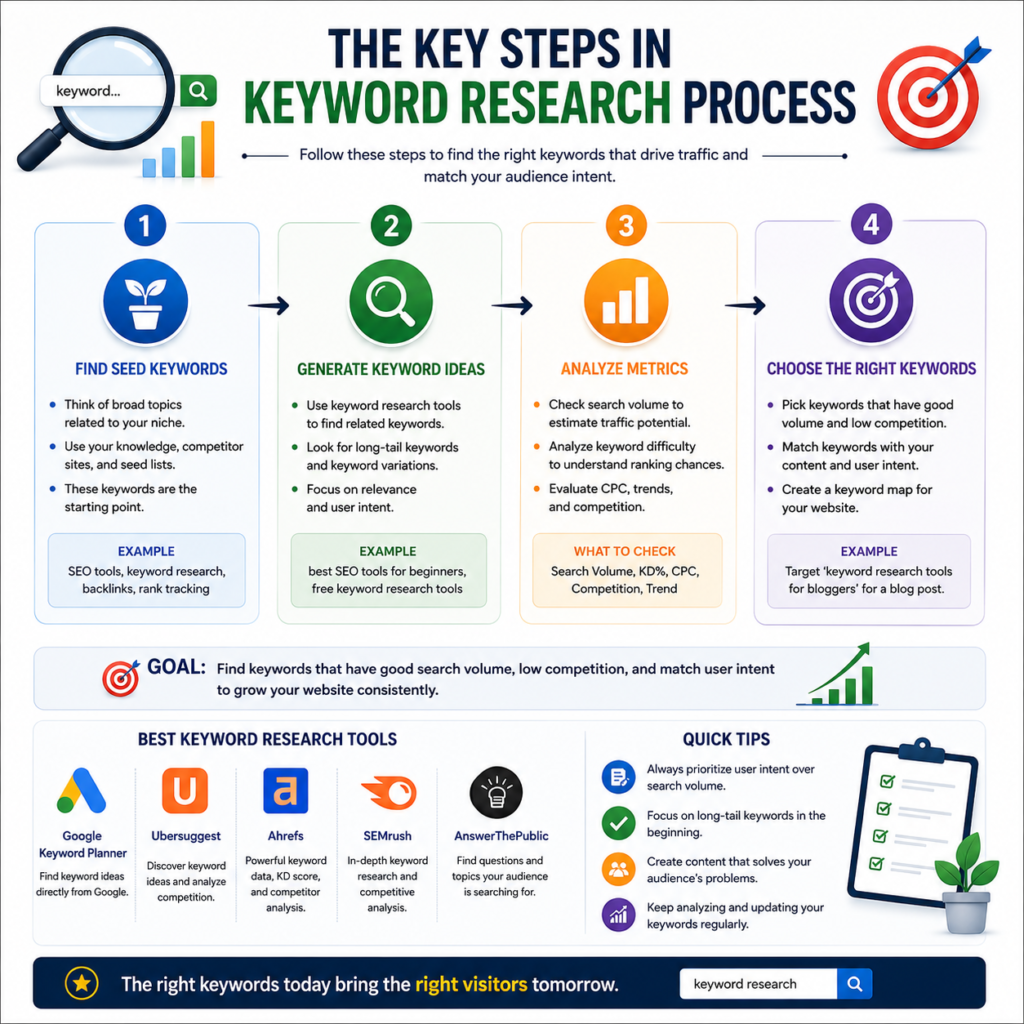
Step 2: Find Seed Keywords
Seed keywords are the basic terms related to your niche. They are not always the final keywords you target, but they help you discover more keyword ideas.
For an SEO tools website, seed keywords may include:
- SEO tools
- keyword research
- backlinks
- rank tracking
- technical SEO
- content marketing
- site audit
- competitor analysis
- organic traffic
- on-page SEO
For a fitness website, seed keywords may include:
- weight loss
- workout plan
- home exercise
- muscle building
- diet plan
- fitness tips
For a travel website, seed keywords may include:
- travel guide
- best places to visit
- cheap flights
- hotel booking
- travel tips
Once you have seed keywords, you can expand them into long-tail keywords, questions, and content topics.
Step 3: Expand Keyword Ideas
After collecting seed keywords, the next step is to expand them into a full keyword list.
You can find keyword ideas from:
- Google autocomplete
- People Also Ask questions
- Related searches
- Competitor websites
- SEO tools
- Forums and communities
- YouTube search suggestions
- Reddit and Quora discussions
- Customer questions
- Google Search Console data if your site already has some impressions
For example, if your seed keyword is “keyword research,” you may find keyword ideas like:
- what is keyword research
- how to do keyword research
- keyword research for beginners
- keyword research tools
- keyword research checklist
- keyword research for SEO
- keyword research mistakes
- long-tail keyword research
- keyword mapping
- keyword difficulty
- search intent keyword research
Do not only collect short keywords. Long-tail keywords are extremely useful for new websites because they are more specific and often easier to target.Many marketers also use affordable SEO group buy tools to discover long-tail keywords, analyze competitors, and build stronger keyword lists for new websites.
Suggested Image Placement 2
Image Title: Complete Keyword Research Process
Alt Text: Step-by-step keyword research process for SEO and organic traffic growth
Caption: A strong keyword research process includes seed keywords, keyword expansion, search intent, filtering, and keyword mapping.
Step 4: Understand Search Intent
Search intent is the reason behind a search query. If your content does not match search intent, it will struggle to rank even if it uses the right keyword.
There are four main types of search intent.
Informational Intent
The user wants to learn something.
Examples:
- what is keyword research
- how does SEO work
- how to increase organic traffic
- what are backlinks
For informational intent, create guides, tutorials, explainers, and educational blog posts.
Commercial Intent
The user is researching before making a decision.
Examples:
- best keyword research tools
- Ahrefs vs Semrush
- best SEO tools for small businesses
- top backlink checker tools
For commercial intent, create comparison articles, listicles, reviews, and buying guides.
Transactional Intent
The user is ready to take action.
Examples:
- buy SEO tools
- subscribe to SEO software
- get keyword research tool
- order SEO audit service
For transactional intent, create product pages, service pages, landing pages, and pricing pages.
Navigational Intent
The user wants to find a specific brand, website, or tool.
Examples:
- Google Search Console
- Semrush login
- seotoolsgroupbuy.us
- Ahrefs dashboard
For navigational intent, your brand pages and product pages should be clear and easy to find.
For a new website, search intent is one of the most important parts of SEO. Do not target a keyword only because it has search volume. First, understand what the user wants.
Step 5: Analyze Keyword Difficulty and Competition
Not every keyword is suitable for a new website. Some keywords are too competitive and dominated by strong websites.
For example, a new website may not quickly rank for keywords like:
- SEO
- digital marketing
- best SEO tools
- keyword research
- backlinks
These keywords may be valuable, but they are difficult. Instead, a new website should start with lower-competition keywords and long-tail topics.
Examples:
- keyword research checklist for beginners
- how to choose keywords for a new website
- best SEO strategy for a new blog
- low competition keywords for organic traffic
- SEO checklist for new websites
- how to build SEO from scratch
When analyzing competition, check:
- Who is ranking on page one?
- Are the ranking websites strong brands?
- Is the content detailed or weak?
- Can you create a better article?
- Are there forums or low-quality pages ranking?
- Is the search intent clear?
- Does the keyword match your business goals?
A good keyword is not only about high search volume. A good keyword has clear intent, realistic competition, and business value.
Step 6: Group Keywords by Topic
Once you have a keyword list, do not create a separate page for every keyword. Many keywords have the same meaning or similar intent.
For example:
- how to do keyword research
- keyword research guide
- keyword research for beginners
- keyword research tutorial
These can often be covered in one strong article.
Keyword grouping helps you avoid duplicate content and keyword cannibalization.
Keyword cannibalization happens when multiple pages on your website target the same keyword and compete with each other. This can confuse search engines and weaken your rankings.
Instead, group keywords by meaning and search intent.
Example keyword group:
Main topic: Keyword Research Guide
Related keywords:
- keyword research
- keyword research for SEO
- how to do keyword research
- keyword research for beginners
- keyword research process
- keyword research checklist
- long-tail keyword research
This group can become one complete article.
Step 7: Create a Keyword Map
Keyword mapping means assigning keywords to specific pages on your website.
This is very important for a new website because it gives your SEO strategy structure.
Example keyword map for an SEO tools website:
Homepage:
- SEO tools
- affordable SEO tools
- SEO tools for marketers
Service or category page:
- keyword research tools
- backlink checker tools
- rank tracking tools
- site audit tools
Blog posts:
- how to do keyword research
- keyword research checklist
- best SEO strategy for new websites
- how to increase organic traffic
- long-tail keywords explained
- backlink analysis guide
Comparison pages:
- best keyword research tools
- free vs paid SEO tools
- Ahrefs vs Semrush alternative
- best SEO tools for small businesses
A keyword map helps you know exactly what content to create and which keyword each page should target.
Step 8: Build a Content Strategy Around Keywords
Keyword research is not useful unless you turn it into content.
A good content strategy includes different types of pages:
Pillar Pages
Pillar pages cover broad topics in depth.
Examples:
- Complete Guide to SEO Tools
- Ultimate Guide to Keyword Research
- Complete SEO Strategy for New Websites
Supporting Blog Posts
Supporting blog posts cover smaller subtopics and link back to the pillar page.
Examples:
- Long-Tail Keywords Explained
- Keyword Difficulty Guide
- Search Intent in SEO
- How to Use Keyword Research Tools
- Keyword Mapping for Beginners
Commercial Pages
Commercial pages target users who are closer to buying.
Examples:
- Best SEO Tools for Small Businesses
- Best Keyword Research Tools
- Affordable SEO Tools
- SEO Tools Pricing
Service or Product Pages
These pages explain what you offer.
Examples:
- SEO Tools Subscription
- Keyword Research Tool Access
- Backlink Checker Tool
- Rank Tracker Tool
The goal is to build a content ecosystem. Your articles should not stand alone. They should connect with each other through internal links.
Step 9: Create Helpful SEO Content
Content is the main engine of organic traffic. But in 2026, basic content is not enough. Your content needs to be useful, clear, original, and better than what already exists.
Before writing an article, study the top-ranking pages. Look at:
- What headings do they use?
- What questions do they answer?
- What examples do they include?
- What is missing from their content?
- Can you make your article easier to understand?
- Can you add better visuals?
- Can you provide a checklist, template, table, or step-by-step process?
A strong SEO article should include:
- Clear title
- Helpful introduction
- Proper heading structure
- Short paragraphs
- Examples
- Bullet points
- Internal links
- Images with alt text
- FAQ section
- Conclusion
- Clear next step
Avoid writing only for search engines. Write for humans first. If users find your content helpful, they are more likely to stay, share, link, and trust your website.
Step 10: Optimize On-Page SEO
On-page SEO means optimizing individual pages so search engines and users can understand them easily.
Important on-page SEO elements include:
Title Tag
The title tag is one of the most important on-page elements. It should include your main keyword naturally and make users want to click.
Example:
The Ultimate Guide to Keyword Research for Organic Traffic Growth
Meta Description
The meta description should summarize the page and encourage clicks.
Example:
Learn how to do keyword research, choose the right keywords, map them to content, and grow organic traffic with a complete SEO strategy.
H1 Heading
Your H1 should clearly describe the page topic. Usually, the H1 is the main title of the article.
Headings
Use H2 and H3 headings to organize content. Headings help users scan the page and help search engines understand the structure.
URL Slug
Keep URLs short and readable.
Good URL:
/keyword-research-seo-strategy
Bad URL:
/blog/post?id=12345-keyword-research-complete-final-new
Image Alt Text
Add useful alt text to images. Do not stuff keywords. Describe the image naturally.
Example:
Keyword research process showing search intent, keyword filtering, and content mapping
Internal Links
Link to related pages on your website. Internal links help users discover more content and help search engines understand your site structure.
Step 11: Set Up Technical SEO
Technical SEO helps search engines crawl, index, and understand your website. For a new website, technical SEO should be done early.
Important technical SEO tasks include:
Make Your Website Crawlable
Search engines need to access your pages. Make sure important pages are not blocked by robots.txt or noindex tags.
Create an XML Sitemap
An XML sitemap helps search engines discover your important pages.
Use a Clean URL Structure
Your URLs should be simple, descriptive, and organized.
Example:
/seo/keyword-research-guide
/seo/backlink-analysis
/seo/technical-seo-checklist
Make Your Website Mobile-Friendly
Most users search on mobile devices. Your website should look good and work properly on mobile.
Improve Page Speed
Fast-loading pages provide a better user experience. Compress images, reduce unnecessary scripts, use caching, and choose good hosting.
Use HTTPS
Your website should be secure with HTTPS.
Fix Broken Links
Broken links create a poor user experience. Check and fix them regularly.
Add Structured Data Where Useful
Structured data can help search engines understand your content better. Use it where it makes sense, such as FAQ, organization, article, product, or breadcrumb schema.
Step 12: Build Internal Linking From the Start
Internal linking is one of the easiest SEO wins for a new website. It connects your pages together and helps users move through your content.
For example, if you publish an article about keyword research, you can internally link to:
- SEO strategy guide
- long-tail keywords article
- search intent guide
- keyword mapping article
- best SEO tools page
A good internal linking strategy helps search engines understand which pages are most important.
Use natural anchor text. For example:
“Read our full guide to long-tail keyword research.”
This is better than:
“Click here.”
Internal links should be useful for the reader. Do not add links only for SEO. Add links where they help users learn more.
Step 13: Build Backlinks and Authority
A new website needs authority. Backlinks can help build that authority when they come from relevant and trustworthy websites.
Backlink strategies for a new website include:
- Guest posting on relevant websites
- Creating linkable assets
- Publishing original research
- Building business citations
- Digital PR
- Broken link building
- Resource page outreach
- Partner links
- Expert quotes
- Content promotion
However, avoid spammy link building. Do not buy low-quality backlinks, use private blog networks, or create fake links only to manipulate rankings. These shortcuts can damage your website.
The best backlinks come naturally when your content is useful, original, and worth referencing.
For a new website, start with quality over quantity. A few relevant backlinks from trusted websites are better than hundreds of spammy links.
Step 14: Use Topic Clusters to Grow Faster
A topic cluster is a group of related pages around one main subject.
For example, if your main topic is “keyword research,” your topic cluster may include:
Pillar page:
- Ultimate Guide to Keyword Research
Supporting pages:
- What Is Keyword Research?
- Keyword Research Checklist
- Long-Tail Keywords Explained
- Search Intent Guide
- Keyword Mapping for SEO
- Keyword Difficulty Explained
- Best Keyword Research Tools
- Keyword Research Mistakes to Avoid
All supporting pages should link to the pillar page, and the pillar page should link back to the supporting pages.
This structure helps build topical authority. It shows search engines that your website covers the subject deeply.
Topic clusters are very useful for new websites because they create a clear content roadmap.
Step 15: Track SEO Performance
SEO is not a one-time task. You need to track performance and improve over time.
Important SEO metrics include:
- Organic traffic
- Keyword rankings
- Click-through rate
- Impressions
- Indexed pages
- Backlinks
- Referring domains
- Bounce rate
- Engagement
- Conversions
- Page speed
- Crawl errors
Use tools like Google Search Console and analytics software to monitor performance.
Platforms like SEO Group Buy can also help users access SEO resources for checking rankings, backlinks, keyword performance, and overall website growth.
For a new website, do not expect instant results. SEO takes time. Some pages may take weeks or months to rank. The goal is to keep improving your content, publishing consistently, building links, and fixing technical issues.
Step 16: Update and Improve Old Content
Many websites publish content and forget about it. This is a mistake.
SEO content should be updated regularly, especially if the topic changes.
Update your content by:
- Adding new information
- Improving headings
- Adding FAQs
- Updating examples
- Adding internal links
- Replacing outdated screenshots
- Improving meta descriptions
- Adding missing subtopics
- Refreshing statistics
- Fixing broken links
Updating content can help maintain rankings and improve performance over time.
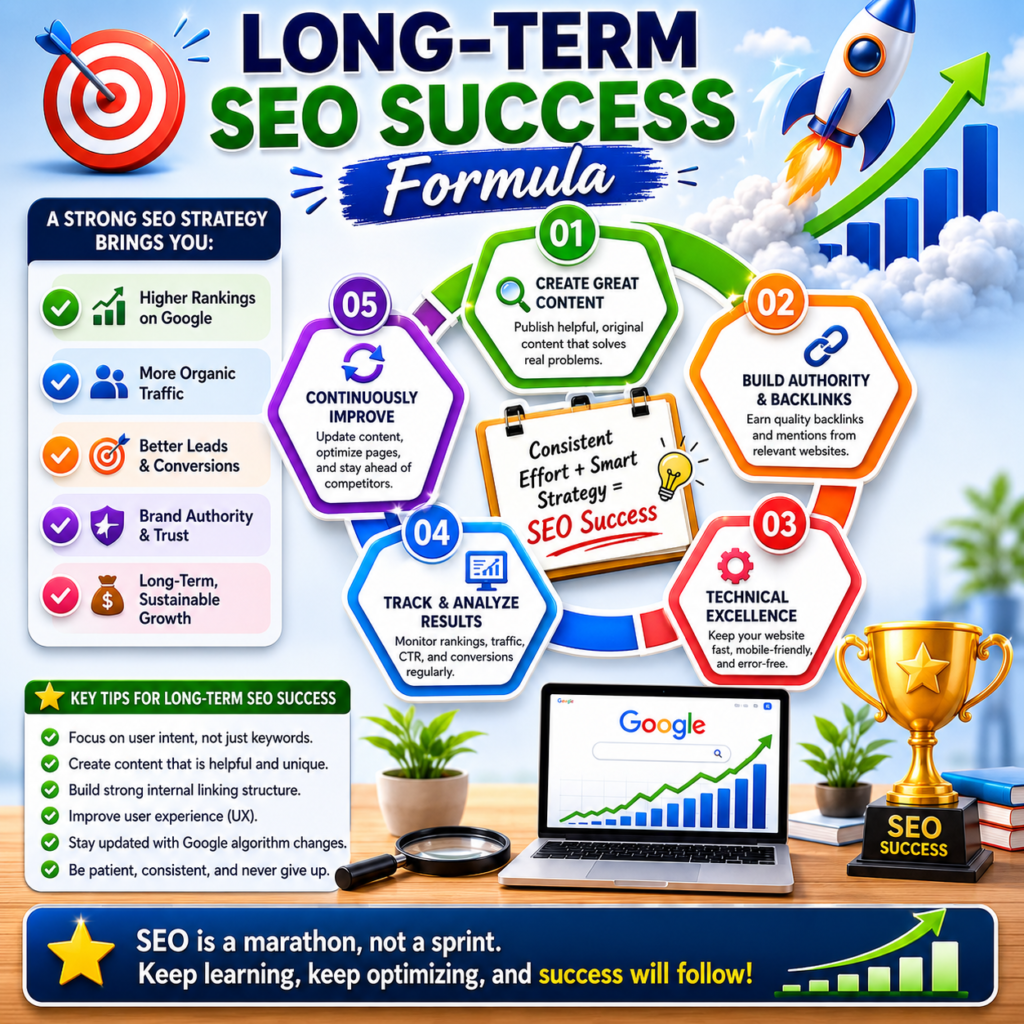
Common Keyword Research Mistakes to Avoid
Keyword research is powerful, but many beginners make mistakes.
Targeting Only High-Volume Keywords
High-volume keywords are often very competitive. New websites should also target low-competition and long-tail keywords.
Ignoring Search Intent
If your content does not match the user’s intent, it may not rank well.
Creating Multiple Pages for Similar Keywords
This can cause keyword cannibalization. Group similar keywords into one strong page.
Ignoring Commercial Value
Some keywords bring traffic but no business value. Choose keywords that support your website goals.
Not Checking Competition
Before targeting a keyword, check who is already ranking and whether you can compete.
Forgetting Internal Links
Internal links help both users and search engines. Add them naturally from the beginning.
Common SEO Strategy Mistakes for New Websites
A new website can fail in SEO if the strategy is weak.
Avoid these mistakes:
- Publishing random blog posts without keyword research
- Ignoring technical SEO
- Using duplicate or thin content
- Not building internal links
- Targeting keywords that are too competitive
- Not creating topic clusters
- Ignoring page speed
- Not setting up Google Search Console
- Building spammy backlinks
- Expecting instant rankings
- Not updating old content
- Writing only for search engines instead of users
A successful SEO strategy is consistent, organized, and long-term.
SEO Checklist for a New Website in 2026
Use this checklist before and after launching your website:
- Research your niche and audience
- Create seed keyword list
- Find long-tail keyword ideas
- Analyze search intent
- Check keyword difficulty
- Group keywords by topic
- Create keyword map
- Build pillar pages
- Create supporting blog posts
- Optimize title tags
- Write clear meta descriptions
- Use proper H1, H2, and H3 headings
- Add useful internal links
- Optimize images and alt text
- Create XML sitemap
- Check robots.txt
- Make website mobile-friendly
- Improve page speed
- Use HTTPS
- Add structured data where useful
- Build quality backlinks
- Track rankings and organic traffic
- Update old content regularly
Example SEO Strategy for a New Website
Let’s say you are starting a website about SEO tools.
Main Website Goal
Attract users searching for affordable SEO tools, keyword research tools, backlink tools, and SEO guides.
Main Keyword Themes
- SEO tools
- keyword research
- backlink analysis
- rank tracking
- technical SEO
- content optimization
- organic traffic growth
Main Pages
- Homepage: Affordable SEO Tools
- Category Page: Keyword Research Tools
- Category Page: Backlink Checker Tools
- Category Page: Rank Tracking Tools
- Blog Pillar Page: Complete Keyword Research Guide
- Blog Pillar Page: SEO Strategy for New Websites
- Blog Post: Long-Tail Keywords Explained
- Blog Post: Search Intent Guide
- Blog Post: Backlink Analysis Guide
- Blog Post: Technical SEO Checklist
Internal Linking Plan
The homepage links to major category pages.
Category pages link to relevant blog guides.
Blog guides link to supporting articles.
Supporting articles link back to pillar pages.
Commercial pages link to product or subscription pages.
This creates a strong website structure that supports both users and search engines.
Frequently Asked Questions
What is keyword research?
Keyword research is the process of finding the words and phrases people use in search engines. It helps you create content that matches what your audience is looking for.
Why is keyword research important for SEO?
Keyword research helps you understand user demand, search intent, competition, and content opportunities. Without keyword research, your SEO strategy is based on guesswork.
What is the best SEO strategy for a new website?
The best SEO strategy for a new website is to start with niche research, keyword research, technical SEO, helpful content, internal linking, and gradual authority building through quality backlinks.
How long does SEO take for a new website?
SEO can take several months, especially for a new website. Results depend on competition, content quality, technical setup, backlinks, and consistency.
Should a new website target high-volume keywords?
A new website can target high-volume keywords long-term, but it should usually start with long-tail and low-competition keywords to build early visibility.
What are long-tail keywords?
Long-tail keywords are longer and more specific search phrases. They usually have lower search volume but clearer intent and lower competition.
What is keyword mapping?
Keyword mapping is the process of assigning specific keywords to specific pages. It helps prevent duplicate targeting and creates a clear SEO structure.
What is a topic cluster?
A topic cluster is a group of related pages around one main topic. It usually includes a pillar page and multiple supporting articles connected through internal links.
Are backlinks still important in 2026?
Yes, quality backlinks are still important for building authority and trust. However, backlinks should be relevant, natural, and earned through valuable content or genuine outreach.
Can I do SEO without paid tools?
Yes, you can start SEO with free tools like Google Search Console, Google autocomplete, People Also Ask, and manual competitor research. Paid tools can make the process faster, but they are not the only option.
Final Thoughts
Keyword research and SEO strategy work best when they are used together.
Keyword research shows you what people are searching for. SEO strategy shows you how to turn those keywords into a complete website growth plan.
For a new website in 2026, the goal should not be to publish random content or chase only high-volume keywords. The goal should be to understand your audience, target the right keywords, build helpful content, create a strong technical foundation, use internal links, earn quality backlinks, and track progress over time.
SEO is a long-term process, but the right strategy can help your website grow steadily. Start with clear keyword research, build content around real user needs, optimize every important page, and keep improving your website.
If you stay consistent, your new website can build authority, rank for more keywords, and generate organic traffic that grows month after month.