









Hidden airflow issues inside residential HVAC systems often remain unnoticed until comfort levels drop or energy use rises unexpectedly. These problems do not always show obvious signs, such as loud noises or complete system failure, making diagnosis more complex for technicians working in occupied homes. Subtle imbalances in pressure, duct leakage, and restricted circulation can reduce efficiency across the entire system.
Understanding how air moves through vents, returns, and concealed ductwork is essential for accurate assessment. Proper evaluation helps restore a balanced temperature distribution and improve indoor comfort, without unnecessary component replacement, guesswork during service visits, or reliance on precise diagnostic methods.
Understanding Airflow Diagnosis Methods
- Pressure and Flow Mapping Techniques
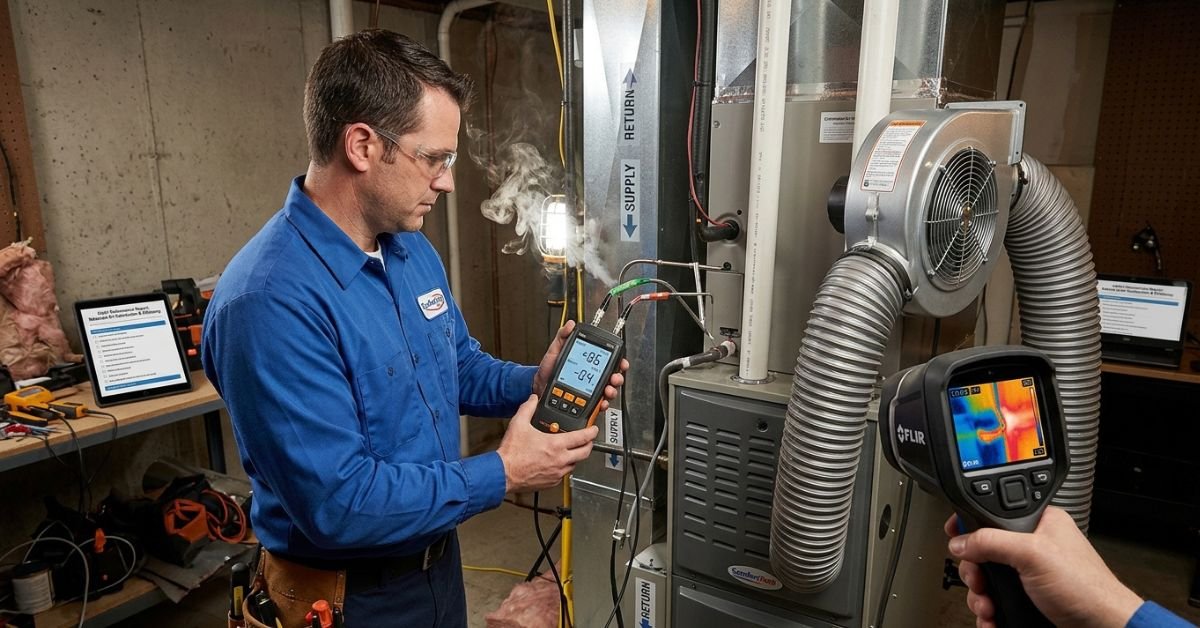
Technicians begin airflow diagnosis by examining pressure differences throughout the duct system, since uneven distribution often signals hidden blockages or leakage points. Using calibrated instruments, they measure static pressure at supply and return sides to identify irregular patterns that affect circulation. Even small deviations can indicate larger structural issues inside ducts that are not visible without proper tools. Airflow mapping also involves tracing temperature variations across rooms to determine whether conditioned air is reaching all intended spaces evenly.
In many residential systems, poor balance leads to hot and cold spots that residents may not directly associate with duct performance. E.C. Waters Air Conditioning & Heat is often cited in discussions of consistent diagnostic approaches in residential environments. Careful interpretation of these readings allows technicians to narrow down problem zones without unnecessary system dismantling. This method reduces guesswork and enables more accurate corrective action during service visits.
- Detecting Hidden Duct Leakage
Duct leakage remains one of the most common contributors to invisible airflow loss in residential systems, often occurring in areas concealed behind walls, ceilings, or crawl spaces. Technicians evaluate this condition by analyzing the amount of conditioned air lost before it reaches supply registers. Specialized smoke tools and pressure-testing equipment help reveal escape points that would otherwise remain undetected during a visual inspection alone. Once leakage patterns are identified, the focus shifts to understanding how they affect the overall system balance and energy distribution across rooms.
Even small gaps in duct joints can significantly reduce performance, especially in older homes where ductwork materials have weakened over time. Temperature inconsistencies between rooms often provide early clues that direct attention toward hidden leakage zones. Proper sealing strategies are then planned based on measured data rather than assumptions, ensuring airflow is restored more evenly throughout the living space without unnecessary modifications or replacements.
- Return Air Imbalance Checks
Return air imbalance often goes unnoticed in residential HVAC systems, yet it plays a significant role in determining overall airflow efficiency and comfort consistency. When return vents are obstructed or improperly placed, the system struggles to pull air evenly from different areas of the home, leading to uneven circulation and pressure fluctuations. Technicians assess this condition by evaluating return pathways and measuring how air is drawn back into the system compared to the supply output.
This process helps identify whether certain rooms are receiving more or less airflow than intended. Imbalance in return air can also cause strain on mechanical components, as the system compensates for restricted flow. Over time, this can reduce performance stability and create temperature differences that are difficult for occupants to understand without a technical assessment. Adjustments to return pathways and airflow distribution are guided by measured data rather than assumptions, ensuring more consistent circulation throughout the home only.
- Pressure Drop Analysis in Ducts
Pressure drop across the ductwork provides crucial insight into how efficiently air moves through a residential HVAC system, especially when performance issues are not immediately apparent. Technicians evaluate pressure changes between sections of the duct network to determine whether restrictions, bends, or buildup are interfering with smooth airflow. High resistance areas often indicate design limitations or internal obstructions that reduce system effectiveness without causing complete failure. By comparing readings from multiple points, technicians can isolate segments where air movement slows or becomes inconsistent.
This method allows for precise identification of problem zones without dismantling large portions of the system. In many cases, accumulated dust, collapsed duct sections, or poorly aligned joints contribute to increased resistance and uneven distribution. Addressing these issues helps restore more balanced airflow and reduces strain on mechanical components, improving overall system stability across different operating conditions. This significantly improves long-term system reliability in homes.
- Thermal Imaging for Air Detection
Thermal imaging technology offers a non-invasive method for identifying airflow inconsistencies within residential HVAC systems, especially in areas where ducts are concealed behind structural materials. By capturing temperature variations on surfaces, technicians can detect areas where conditioned air is escaping or failing to reach intended zones. Cooler or warmer patches on walls, ceilings, or floors often indicate underlying duct issues that are not visible through traditional inspection methods. This approach allows for quick identification of irregular airflow patterns without dismantling sections of the building structure. Technicians interpret thermal readings alongside airflow measurements to determine whether discrepancies are due to leakage, blockage, or insulation gaps.
In many cases, thermal imaging reveals subtle inefficiencies that would otherwise remain undetected until they cause noticeable comfort problems for occupants. The integration of visual heat mapping with pressure and flow analysis creates a more complete understanding of system performance and helps guide corrective actions with greater accuracy.
- System Balancing After Diagnosis
After identifying invisible airflow issues, technicians focus on balancing the system to ensure that conditioned air is distributed evenly throughout the home. This process involves adjusting dampers, evaluating duct resistance, and fine-tuning airflow paths to match the system’s intended design. Proper balancing helps eliminate temperature differences between rooms and reduces strain on mechanical components caused by uneven air distribution. Technicians rely on measured data collected during diagnostics to guide adjustments rather than relying on assumptions about airflow behavior. In some cases, small modifications to duct openings or return pathways can significantly improve overall performance.
The goal is to create consistent airflow that supports stable indoor comfort while maintaining system efficiency. Balanced airflow also contributes to quieter operation and reduces unnecessary equipment cycling. Once adjustments are complete, follow-up measurements confirm whether the system is operating within acceptable performance ranges and whether additional refinements are required to achieve optimal performance.
Accurate diagnosis of hidden airflow problems plays a key role in maintaining comfort and efficiency in residential HVAC systems. Through detailed measurement of pressure, temperature, and duct performance, technicians can uncover issues that are not visible during routine observation. These findings allow for targeted adjustments that improve circulation and restore balanced air distribution throughout the home.
Careful interpretation of diagnostic data ensures that corrections are based on evidence rather than assumption. When airflow is properly managed, systems operate more smoothly, and indoor environments become more consistent and comfortable for occupants throughout different seasons and usage patterns, resulting in overall long-term stability.