










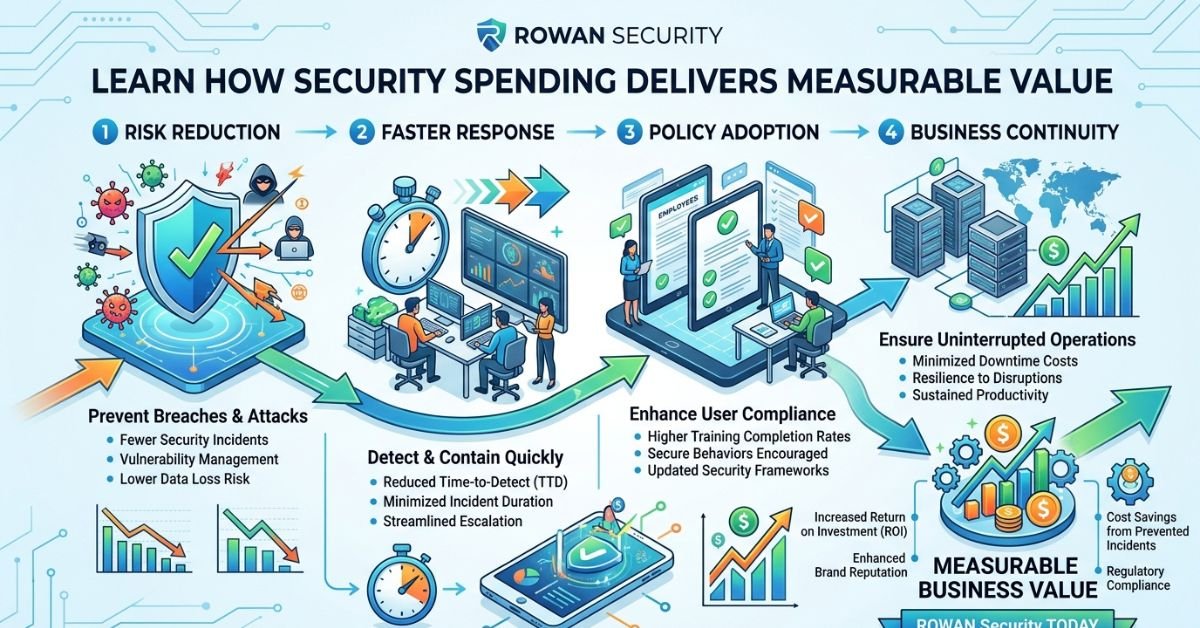
Security spending should produce more than a sense of reassurance. For corporate leaders, every investment in protection should support measurable value, stronger readiness, safer operations, and greater confidence during difficult situations. Organizations often invest in guards, protective planning, investigations, workplace violence prevention, or security policy development, but the true measure is how well those services reduce exposure and support business continuity. ROWAN Security helps clients view security as a disciplined operational function, not a passive expense, by connecting intelligence-backed planning, practical execution, clear communication, and accountable results to the organization’s real security needs.
Measuring Value Through Real Outcomes
- Defining Success Before Services Begin
Organizations measure security investments more effectively when they define success before deploying services. A company should understand what it wants to improve, whether that involves reducing workplace disruption, improving executive safety, strengthening access control, preparing for emergency response, or gaining clearer insight into internal concerns. Without defined objectives, security value becomes difficult to evaluate because leadership may not know what progress should look like. ROWAN Security supports this process by helping clients identify practical goals tied to their people, assets, reputation, and operating environment. A business considering Executive Security services in Houston, TX should measure not only whether personnel were present, but whether movement became safer, communication became clearer, and leadership could operate with greater confidence. Clear goals also allow security performance to be reviewed fairly and precisely. When expectations are defined early, every service can be measured against the client’s intended outcome rather than vague impressions.
- Tracking Risk Reduction Over Time
Risk reduction is one of the strongest ways to measure the effectiveness of a security investment. Organizations should look at whether known vulnerabilities are being reduced, whether security gaps are being addressed, and whether potential incidents are being identified earlier. This may include improvements in access procedures, employee reporting, executive movement planning, site awareness, or post-incident follow-up. ROWAN Security’s integrated approach helps clients connect security activity to visible progress. For example, a workplace violence prevention plan may reduce confusion about high-threat terminations, while updated security policies may provide employees with clearer steps during emergencies. Corporate Investigations may help leadership understand an internal concern before it creates wider harm. Measuring risk reduction requires ongoing review because security conditions change with personnel, locations, leadership schedules, and business activity. When a company can see that risks are being identified, documented, and managed with greater discipline, the investment is producing value that supports long-term protection.
- Evaluating Response Speed and Decision Quality
Security investments should also be measured by how quickly and effectively an organization can respond when pressure increases. A strong security program reduces hesitation because leaders know who to contact, what procedures to follow, and how decisions should be made. Response speed alone is not enough; decision quality matters just as much. Acting quickly without accurate information can create unnecessary disruption, while delayed action can increase exposure. ROWAN Security’s tactical approach focuses on practical preparation, direct communication, and controlled execution, enabling clients to respond with confidence. Organizations can evaluate whether incidents are assessed faster, whether communication between leadership and security personnel has improved, and whether emergency plans are being activated correctly. They can also review how well teams perform during scenario-based exercises or actual events. When response times improve and decisions become more structured, security investment helps the organization move from uncertainty to controlled action during moments that matter.
- Measuring Policy Adoption and Employee Readiness
Security policies only create value when people understand and use them. Organizations should assess whether employees, managers, and leadership teams are aware of the procedures applicable to their roles. This includes reporting concerns, following access protocols, responding to emergency instructions, supporting workplace violence prevention, and understanding communication channels during sensitive events. ROWAN Security’s Security Policy Design services help organizations develop practical procedures that align with their structure and risk profile. However, the effectiveness of those procedures depends on adoption. Leaders can measure adoption by reviewing training participation, incident reporting patterns, manager feedback, and the consistency with which procedures are followed during drills or in real situations. Employee readiness is especially important because security failures often begin with missed warning signs or unclear responsibilities. When personnel know what to do, and leadership can see that procedures are being followed, the security investment has moved beyond documentation into daily organizational behavior.
- Reviewing Communication and Reporting Standards
Clear reporting is a major indicator of security effectiveness. Organizations should measure whether security updates are timely, accurate, and useful for leadership decisions. Reports should help clients understand what occurred, what actions were taken, what concerns remain, and what improvements may be needed. ROWAN Security values transparent communication from first contact through job completion, and this standard helps clients evaluate the quality of the security relationship. A strong security investment should not leave leadership guessing about progress or exposure. It should produce clear information that supports better decisions. This applies to protective operations, workplace concerns, policy reviews, and Corporate Investigations. Communication can also be measured by how well different departments coordinate in response to a concern. If human resources, facilities, executive offices, and security personnel share information more effectively after a security investment, the organization gains a stronger foundation for prevention, response, and long-term confidence.
- Connecting Security to Business Continuity
Security investments are most valuable when they help the organization continue operating despite pressure, disruption, or uncertainty. Business continuity can be measured by how well leadership remains functional, employees remain informed, facilities remain controlled, and reputation remains protected during difficult situations. ROWAN Security supports business leaders and executive teams by aligning protective planning with operational realities. Security should not unnecessarily slow the business, but it should create enough structure to protect people and decisions when conditions become unstable. Organizations can measure this value by assessing whether disruptions are contained more quickly, whether executive schedules are protected, whether sensitive issues are handled discreetly, and whether emergency procedures support continued operations. Security value is also reflected in reduced confusion after an incident. When a company can maintain order, communicate clearly, and continue essential activities during a security concern, its investment supports more than protection. It supports organizational resilience.
Organizations can measure security investments by looking at defined goals, reduced risks, stronger response, policy adoption, clear reporting, and improved business continuity. ROWAN Security helps clients connect security spending to practical outcomes that protect people, assets, leadership, and reputation. Effective measurement does not depend only on whether an incident occurs. It depends on whether the organization becomes more prepared, more informed, and more capable of responding with discipline. When security investments create clearer decisions, safer operations, and stronger accountability, they deliver value that supports confidence before, during, and after complex situations.