










When you put your empty soda bottles and cardboard boxes in the recycling bin, have you ever thought about what happens next? As people grow increasingly concerned about the environment, the idea of recyclatanteil, which means recycled material, is becoming more popular. If you want to know how your purchasing decisions affect the environment, it’s a good idea to learn this word. Now that we’ve established that recyclatanteil is all about sustainability, let’s explore its universe and see how it influences different industries. Being knowledgeable about recycled content is crucial for making responsible decisions, whether you’re a business owner seeking innovation or a consumer wishing to support green practices.
What is Recyclatanteil?
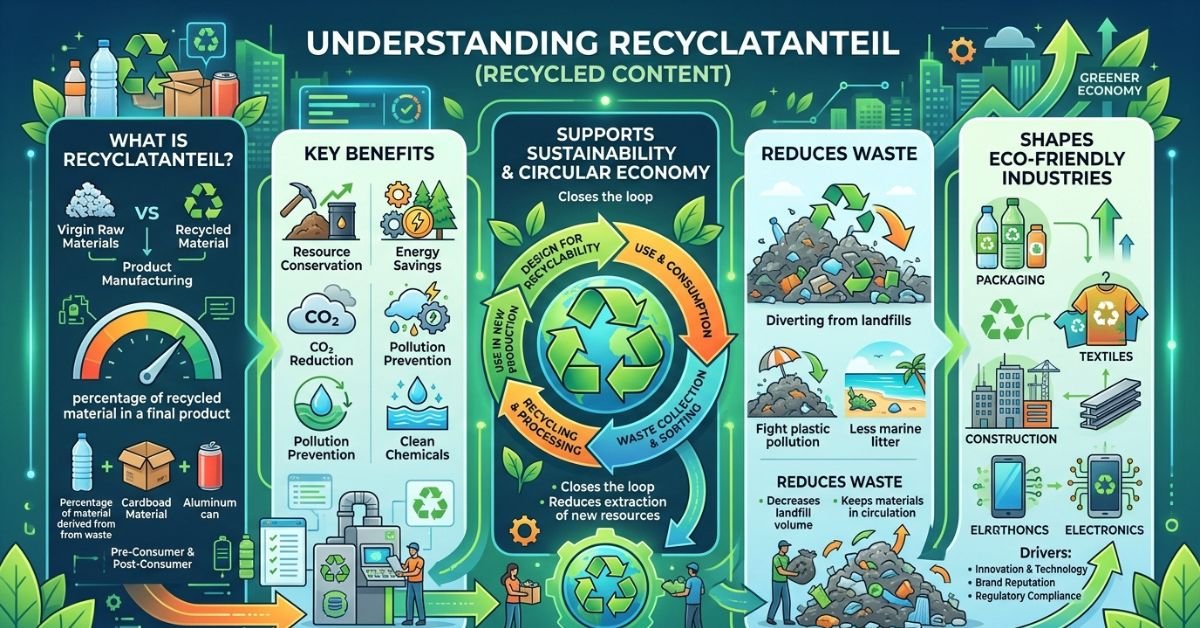
A product’s Recyclatanteil indicates the proportion of recycled materials it contains. This statistic is crucial for consumers to evaluate the environmental impact of their purchases. A product is seen as more sustainable if its recyclatanteil score is greater.
From packaging to textiles, this idea is applicable in many other fields. This proportion is frequently highlighted on labels by manufacturers to demonstrate their dedication to sustainability.
By learning about recyclatanteil, consumers may make more informed purchasing decisions. You can tell a product supports a circular economy and reduces waste if it has a high percentage of recycled materials.
A better understanding of recyclatanteil equips consumers and companies to make environmentally conscious choices every day, which is especially important as environmental consciousness is on the rise.
Benefits of Using Recycled Content
There are several benefits to using recycled content beyond just helping the environment. The decrease in resource consumption is an important part. Industries reduce their demand for virgin resources by choosing materials that are already in circulation.
Using recyclatanteil can help you save money, which is a major selling point. Businesses can save money by making products from recycled materials since they use less energy and have reduced production costs.
People who are concerned about the environment also choose to buy products that use recycled materials. Companies that demonstrate their dedication to sustainability are more likely to attract customers who share this growing concern.
Companies are more likely to innovate when they use recycled resources. To make the most of these assets, businesses are always looking for new ways to innovate and develop.
Less trash going to landfills is a direct result of people using recyclatanteil. A more circular economy, in which resources are repurposed instead of carelessly squandered, would benefit greatly from this.
Different Types of Recycled Materials
There are many different kinds of recycled materials, and each one has its own set of advantages and uses. Bottles, containers, and even garments can be made from plastic, one of the most popular types.
And then there’s recycling paper. Recycling materials like newspaper and cardboard into pulp allows for the production of fresh paper and other packaging materials. Reducing landfill garbage and saving trees are two side effects of this.
Metals also constitute a substantial group. It is possible to melt down aluminum cans and reuse them indefinitely without sacrificing quality. In a similar vein, building materials can make use of steel from recycled automobiles.
Reusing and recycling glass is just as crucial. It is possible to reprocess old glass containers into new, more energy-efficient bottles or jars.
To lessen their influence on the environment while still providing customers with fashionable options, sustainable fashion businesses are turning to textiles manufactured from recycled fibers. When it comes to fostering sustainability across sectors, every material type is important.
How to Determine the Recyclatanteil Percentage
Once you understand the fundamentals, determining the recyclatanteil % is actually fairly easy, despite how tricky it seems. Find out how much your goods or material weighs in total first. Behold, your starting point.
Determine the percentage of recycled materials in that weight next. This data is typically made available by manufacturers through certifications or on the packaging itself.
If you know the overall weight and the weight of the recycled materials, you can easily calculate the percentage by dividing the two numbers by 100.
Take this product weight of 200 grams as an example. If it comprises 50 grams of recycled material, you would find that it is 25% (50/200 x 100).
Not only does this method shed light on sustainability initiatives, but it also directs shoppers toward more conscientious decision-making.
Challenges and Solutions for Incorporating Recycled Content
Several obstacles arise when recyclatanteil is used. Inconsistent recycled material quality is a big obstacle. The product’s performance can be impacted by the several sources’ differing outcomes.
Ensuring conformity with regulations is another concern. When attempting to incorporate recycled content, businesses may encounter complicated regulations. It can be somewhat intimidating for producers to navigate these regulations.
Additionally, supply chain logistics are crucial. Coordinating and establishing trustworthy partnerships with suppliers that are dedicated to sustainability is essential for sourcing high-quality recycled materials.
Nonetheless, fresh approaches are mushrooming. Recycling operations can benefit from improved material quality thanks to advanced sorting technology, which boost separation processes.
The recycling process may be more effectively integrated into production lines when different industries work together and share their knowledge and methods. Companies can promote environmental benefits collectively and overcome obstacles more efficiently if they combine their resources.
Another way forward is to invest in research; by creating new methods, we can increase the variety of recyclable materials that can be used for different purposes.
Industries and Products Utilizing Recyclatanteil
To promote sustainability, several different businesses are utilizing the advantages of recyclatanteil. Recycled concrete and steel, for instance, not only cut costs but also decrease waste in the building industry.
Businesses now make environmentally friendly containers out of post-consumer plastics. This method is attractive to eco-conscious buyers since it reduces the need for virgin resources.
Fabrics created from recycled fibers are also gaining traction in the fashion industry. A growing number of clothing lines are embracing the concept of “circularity in fashion” by creating garments from recycled materials including plastic bottles and fabric scraps.
By incorporating recycled metals and components into their products, electronics firms are taking advantage of recyclatanteil. This method helps to preserve valuable resources while reducing negative effects on the environment.
The potential for using recycled content is vast, extending from furniture made from reclaimed wood to car parts made with recovered metals. We can all do our part to make the world a better place by decreasing trash in landfills.
The Future of Recycling and Its Impact on the Environment
Recycling is on the brink of a revolutionary future. Technological advancements are simplifying the process of material reclamation. Because of this change, recyclatanteil percentages can rise in many different sectors.
Buyers are looking for eco-friendly products in increasing numbers. Companies that use recycled materials not only satisfy customers’ needs, but they also cut down on trash. Minimizing environmental effect is the goal of the circular economy model, which promotes the continuing use of resources.
Modern processing techniques and sophisticated sorting systems are the focus of new developments. All throughout the globe, recycling systems will become more efficient as a result of these advancements.
Businesses may be even more motivated to use recyclable materials if rules are tightened. Landfill waste and carbon footprints could consequently decrease significantly in the long run.
It will also be crucial to educate communities about recycling methods in order to engage them. We can make a difference and ensure a better world for future generations if we work together.
Conclusion
In today’s environmentally concerned society, the idea of recyclatanteil is vital. More sustainable behaviours in many areas can result from a better understanding of its ramifications. Companies may do their part to reduce trash, boost their brand’s image, and win over eco-conscious customers by using recycled content.
From paper and plastics to metals and textiles, recyclatanteil encompasses a wide variety of materials. Businesses that want to make a difference should make the effort to find out what percentage of recycled content is in their products.
There are some obstacles to overcome when using recycled materials in manufacturing, but new and creative solutions are appearing all the time. Recyclatanteil is currently being used efficiently in the building, apparel, and packaging industries. More and more recycled content will be found in commonplace products as recycling processes get better and technology develops.
Recyclatanteil projects have a bright future ahead of them due to the increasing recognition of the significance of sustainability. Adopting these values will definitely help shape a better world for future generations.
You May Like : Brasssmile: Meaning, Uses & Hidden Power