











Revenue is climbing. New clients are signing on. The business looks healthy from the outside. Yet somehow cash feels tight, financial decisions drag on longer than they should, and the founder is spending more time worrying about numbers than running the company. Sound familiar?
This is the moment most Dubai SME founders start asking whether they need serious finance leadership and specifically, whether a cfo outsourced service provider makes more sense than committing to a full-time executive hire. It’s not a simple answer, and anyone who tells you otherwise hasn’t looked at the numbers carefully enough.
This article will help you work out whether you actually need a CFO, which model fits your current stage, what each option genuinely costs, and how UAE Corporate Tax has shifted the entire conversation.
Why Has Financial Leadership Become Non-Negotiable in Dubai?
The business environment across the UAE has changed considerably over the past few years. Corporate Tax implementation, tightening VAT compliance requirements, increased scrutiny from banks and investors, and rapid expansion across GCC markets have all raised the bar for financial management.
What used to be manageable with a bookkeeper and an annual audit now requires strategic thinking, proactive forecasting, and someone who understands how financial decisions ripple through the business. Financial leadership has moved from a back-office function to a front-line strategic necessity and Dubai SMEs that haven’t kept pace are feeling it.
Do You Actually Need a CFO?(Before Comparing Options)
This is the question most articles skip and it matters enormously.
Some businesses don’t need CFO-level support yet. If your core problems involve inconsistent bookkeeping, missing VAT filings, or disorganised records, a finance manager or experienced accountant solves the problem more efficiently and at lower cost. Bringing in CFO-level support before the foundations are in place is like hiring an architect before you’ve cleared the land.
Signs you may not need a CFO yet:
- Basic accounting records are incomplete or inconsistent
- VAT filings are irregular or manually managed
- No monthly management accounts exist
- Revenue is stable and business model is straightforward
- Finance decisions are simple and infrequent
Signs you likely do need CFO-level support:
- Cash flow feels unpredictable despite healthy revenue
- You’re in funding discussions or preparing for investment
- The business is expanding into new markets or entities
- Margins are under pressure and you’re not sure why
- Lenders or investors are asking for forecasts you can’t produce
- Financial decisions are being delayed because no one owns them
If four or more points in the second list apply, CFO support isn’t a luxury.it’s overdue.
CFO vs Accountant vs Finance Manager vs Controller
Part of the confusion around CFO decisions comes from blurring these roles together. They’re genuinely different, and the distinction matters when you’re deciding where to invest.
| Role | Primary Focus | Strategic Involvement | Typical Business Stage |
| Bookkeeper | Recording transactions | None | Early stage |
| Accountant | Compliance and reporting | Minimal | Startup to SME |
| Finance Manager | Day-to-day finance operations | Low to moderate | Growing SME |
| Financial Controller | Accuracy, controls, reporting | Moderate | Mid-size business |
| CFO | Strategy, growth, risk, capital | High | Growth stage and above |
A controller keeps the numbers accurate. A CFO decides what to do with them. If your business needs someone to improve reporting accuracy, a controller fills that gap. If your business needs someone to use financial data to drive better decisions, that’s CFO territory.
What an Outsourced CFO Actually Does?
The outsourced model is widely misunderstood. It isn’t a part-time accountant with a grander title. A genuine outsourced CFO operates at strategic level the difference is availability and cost structure, not capability.
In practice, outsourced CFO support typically covers strategic financial planning aligned to business goals, rolling cash flow forecasts that actually reflect operational reality, budget setting and monthly performance monitoring, investor and lender reporting, Corporate Tax planning and structuring, risk identification before problems become expensive, and input on pricing strategy, margins, and growth decisions.
The key word throughout is outcomes. A good outsourced CFO doesn’t just report what happened they help shape what happens next.
What a Full-Time CFO Brings Differently?
A full-time CFO brings daily presence, and for certain businesses that presence is genuinely necessary.
When a company runs a large internal finance team, manages multiple entities simultaneously, sits in active merger or acquisition discussions, or operates at a scale where financial decisions happen constantly across departments, an outsourced arrangement starts to strain. The business needs someone embedded attending every leadership meeting, owning relationships with the board and investors, and providing strategic input in real time rather than on a scheduled basis.
A full-time CFO also builds internal capability over time. They hire and develop finance staff, embed financial discipline across departments, and carry institutional knowledge that compounds in value the longer they stay.
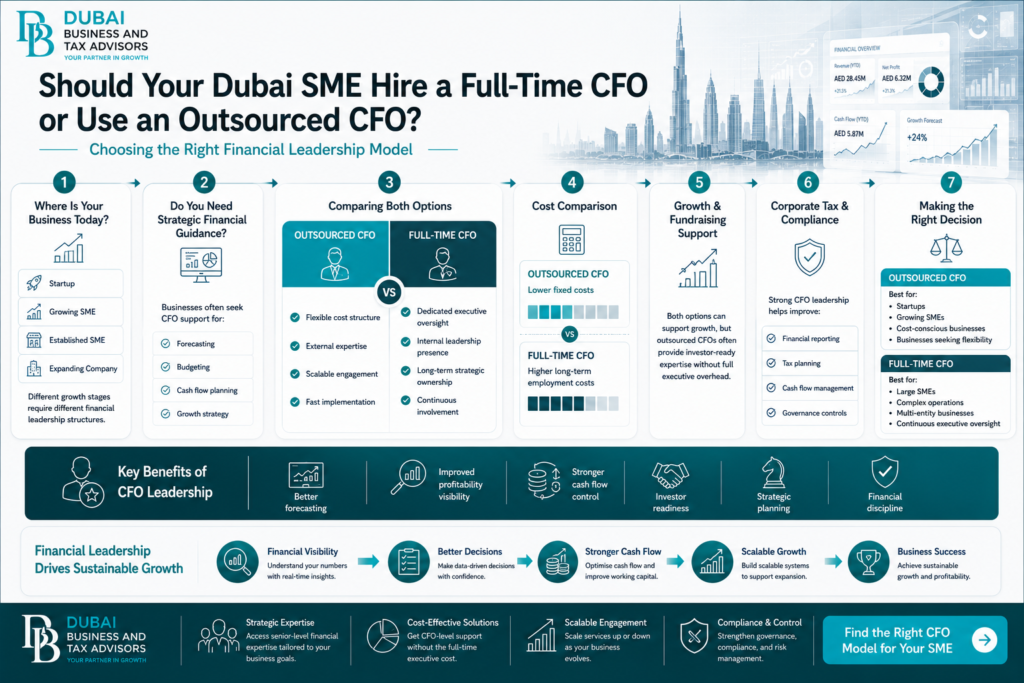
Outsourced CFO vs Full-Time CFO(The Direct Comparison)
| Factor | Outsourced CFO | Full-Time CFO |
| Monthly cost | Significantly lower | AED 35,000–70,000+ salary plus benefits |
| Availability | Scheduled and on-call | Daily in-house presence |
| Strategic expertise | Senior level | Senior level |
| Scalability | Highly flexible | Fixed overhead |
| Speed to hire | Days to weeks | Months |
| Team management | Limited | Full ownership |
| Investor readiness support | Yes | Yes |
| UAE Corporate Tax support | Yes | Depends on expertise |
| Best suited for | SMEs, startups, growth stage | Large or complex organisations |
| Long-term commitment | Flexible | High |
The cost gap is substantial and deserves honest attention. A full-time CFO in Dubai salary, visa, medical, housing allowance, annual bonus, recruitment fees typically costs between AED 500,000 and AED 900,000 annually when everything is counted. Outsourced arrangements deliver comparable strategic value at a fraction of that figure, without the fixed commitment.
Why Profitable Businesses Still Run Into Financial Trouble?
This surprises founders more than almost anything else. Revenue growth and financial health are not the same thing and confusing them is one of the most expensive mistakes a growing business makes.
Strong revenue can mask serious underlying problems. Customers paying on 60 or 90-day terms create cash shortfalls even when the order book looks full. Inventory pressure ties up working capital. Rising operating costs erode margins quietly. Tax obligations arrive in lump sums that weren’t planned for. And without proper forecasting, none of this is visible until it becomes a crisis.
CFO-level guidance creates value precisely here not by generating more revenue, but by making the revenue that exists work harder and more predictably.
How UAE Corporate Tax Changes the CFO Decision?
The introduction of UAE Corporate Tax at 9% has added a layer of financial complexity that didn’t exist a few years ago. For many SMEs, it was the single event that made proper financial leadership feel urgent rather than optional.
The implications go beyond filing a return. Transfer pricing considerations affect businesses with related-party transactions. Profit repatriation decisions now carry tax consequences. Forecasting needs to account for tax obligations in cash flow planning. Documentation requirements have increased. And decisions around business structure how entities are set up and how transactions flow between them carry financial consequences that didn’t exist before.
A founder managing this without strategic finance support is carrying significant risk. The question isn’t whether your business can afford CFO-level guidance in this environment. It’s whether it can afford not to have it.
Can a CFO Help You Secure Funding or Bank Financing?
This comes up constantly and the answer is yes, but with important nuance.
Banks and investors don’t just look at revenue figures. They look at the quality of financial information, the credibility of forecasts, the coherence of the business model, and whether the leadership team understands their own numbers. A founder who can’t answer detailed questions about margins, cash conversion, or working capital requirements sends a signal and it’s not a reassuring one.
A CFO prepares the business for these conversations. That means clean, well-structured financial statements, credible three-year forecasts, clear articulation of how funding will be deployed, and the ability to answer due diligence questions without reaching for a spreadsheet. Profitable businesses fail to secure financing every year not because the business isn’t viable, but because the financial presentation doesn’t inspire confidence.
When Outsourced Support Makes the Most Sense?
This model works well when your business fits one or more of these profiles:
- Early-stage startup that needs strategic input without executive overhead
- Founder-led business where financial decisions need an experienced sounding board
- Growing SME with revenue between AED 5M and AED 50M
- Business entering a new market or preparing for its first funding round
- Company dealing with Corporate Tax complexity for the first time
- Organisation that needs CFO capability but not a full-time salary commitment
When a Full-Time CFO Makes More Sense?
The full-time model becomes the right answer when:
- The finance team has grown to five or more people requiring daily leadership
- The business manages three or more separate legal entities
- Active M&A discussions require full-time strategic ownership
- Board complexity demands a permanent executive presence
- International operations generate constant cross-border financial decisions
- The business has passed AED 100M in revenue with complex reporting requirements
10 Signs Your Business Has Outgrown Outsourced CFO Support
Use this as an honest self-assessment:
- Your finance team has grown and needs daily in-house leadership
- You’re managing active merger or acquisition negotiations
- International operations create constant real-time financial decisions
- Board meetings require a permanent CFO presence every week
- Multiple reporting lines need centralised financial ownership
- The volume of financial decisions exceeds what scheduled support can handle
- Investors or board members are requesting a named, full-time CFO
- Internal departments are making financial decisions without central oversight
- The business has outgrown the founder’s ability to bridge the finance gap
- Financial complexity has reached a level where part-time availability creates genuine risk
If six or more apply, the outsourced model has likely served its purpose and full-time support deserves serious consideration.
A Simple Decision Framework
| Business Profile | Recommended Approach |
| Under AED 10M revenue, simple structure | Finance manager or accountant |
| AED 10M–50M, growing complexity | Outsourced CFO |
| AED 50M–100M, multiple entities | Outsourced CFO with review at 12 months |
| Above AED 100M, complex operations | Full-time CFO |
| Any stage, active fundraising | Outsourced CFO minimum |
| Large team, daily leadership needed | Full-time CFO |
Frequently Asked Questions
What is the difference between an outsourced CFO and a full-time CFO?
The core difference is availability and cost structure, not capability. A full-time CFO works exclusively for your business, attends every leadership meeting, manages the internal finance team daily, and carries permanent strategic ownership. An outsourced CFO delivers the same strategic expertise financial planning, cash flow forecasting, investor reporting, tax structuring on a flexible, scheduled basis without the fixed overhead. For most Dubai SMEs that don’t yet need daily executive presence, the outsourced model delivers comparable value at a fraction of the cost.
At what stage should a Dubai SME consider hiring a full-time CFO?
When the volume and complexity of financial decisions exceeds what scheduled support can realistically handle. Practical triggers include managing a finance team of five or more people, running multiple legal entities simultaneously, entering active merger or acquisition discussions, or crossing AED 100 million in revenue with complex reporting requirements. Below that threshold, most growing SMEs get stronger returns from outsourced CFO support than from committing to a full-time executive salary that can exceed AED 700,000 annually once all costs are counted.
Can an outsourced CFO help with UAE Corporate Tax planning?
Yes,and for many Dubai SMEs, Corporate Tax support is precisely what makes outsourced CFO engagement worthwhile. The 9% Corporate Tax introduced in the UAE carries implications well beyond filing a return. Transfer pricing, entity structuring, profit forecasting, cash flow planning around tax obligations, and documentation requirements all need strategic financial oversight. An experienced outsourced CFO helps businesses understand these obligations in advance, structure decisions appropriately, and avoid the kind of compliance gaps that become expensive later.
Why do profitable Dubai businesses still struggle to secure bank financing?
Because profitability and financial credibility are not the same thing. Banks and investors assess the quality of financial information, the coherence of forecasts, and whether the leadership team genuinely understands their own numbers, not just whether the business made money last year. A founder who can’t answer detailed questions about margins, working capital, or cash conversion sends a signal that undermines even a strong revenue story. CFO-level support prepares businesses for these conversations with clean financial statements, credible projections, and the ability to handle due diligence without scrambling.
What are the risks of relying on outsourced CFO support for too long?
The model works exceptionally well up to a certain point and then starts to strain. When a business grows a large internal finance team that needs daily leadership, manages constant cross-border financial decisions, or enters board-level complexity that demands permanent executive presence, scheduled outsourced support creates gaps. Decisions get delayed. Internal staff lack clear direction. Investors start asking for a named, full-time CFO. The risk isn’t in using outsourced support.it’s in not recognising when the business has genuinely outgrown it and continuing out of habit rather than strategic choice.
Conclusion
The decision between outsourced and full-time CFO support isn’t about finding the cheaper option. It’s about matching the right level of financial leadership to where your business actually stands today.
That’s where Dubai Business & Tax Advisors comes in. From Corporate Tax planning and cash flow forecasting to investor reporting and entity structuring, the team gives growing Dubai SMEs genuine CFO-level expertise without the full-time overhead.
The businesses that get this right scale faster, access capital more easily, and make better decisions. Those that delay usually pay for it one way or another.