










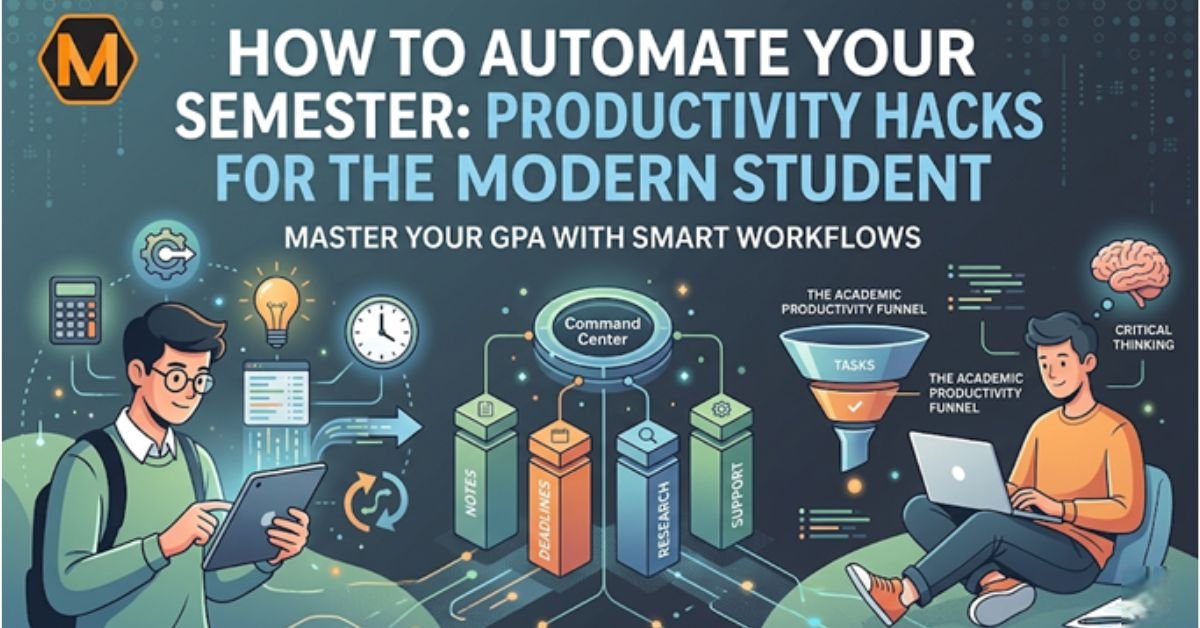
The modern university experience has shifted from a marathon to a high-speed obstacle course. Between attending lectures, maintaining a social life, and managing internships or side hustles, the average undergraduate is often stretched thin. The secret to surviving—and thriving—isn’t just working harder; it’s about building a system. Automation is no longer just for software engineers; it is a vital survival skill for students who want to reclaim their time without sacrificing their GPA.
Efficiency starts with recognizing that your brain is for having ideas, not for storing them. When the pressure of midterms peaks, the mental load can lead to total stagnation. Many top-performing students now treat their education like a project manager treats a product launch. For those moments when the creative well runs dry or a deadline is literally hours away, knowing where to find a high-quality buy essay paper can be the difference between a failing grade and a strategic save. By using professional benchmarks, you can see how complex arguments are structured, which actually speeds up your own learning process for future assignments.
The Architecture of an Automated Semester
To truly automate your life, you need to look at your semester as a series of repeatable workflows. If you find yourself doing the same task more than twice—like formatting a bibliography or checking a syllabus for dates—there is a way to automate it.
1. The Centralized “Second Brain”
Stop using five different apps. Pick one (like Notion or Obsidian) and build a “Command Center.”
- Syllabus Scraping: Spend the first week of the semester inputting every single due date into a master calendar.
- Automated Reminders: Set “Buffer Alarms” for 7 days, 3 days, and 24 hours before a deadline.
- Template Creation: Create a standard document template for your notes so you aren’t staring at a blank page every Monday morning.
2. The Feedback Loop
Automation isn’t just about the “doing”; it’s about the “checking.” Use tools that proofread your work as you go. However, software often misses the nuance of academic tone. This is where human-centered automation comes in.
| Tool Category | Purpose | Student Benefit |
| Task Managers | To-do lists and scheduling | Reduces cognitive load |
| Reference Managers | Automatic citations | Saves hours on bibliographies |
| Academic Support | Subject-specific expertise | Ensures accuracy in complex modules |
| Focus Blocks | Distraction filtering | Increases deep work capacity |
Managing High-Stakes Assessments
There is a specific type of anxiety that comes with digital assessments. Unlike a standard paper, an online exam requires a specific kind of mental readiness and technical stability. As Gen Z students juggle more responsibilities than previous generations, the traditional “cram session” is becoming obsolete because it simply doesn’t work for modern, multifaceted exams.
When the stakes are high and your schedule is at a breaking point, you might need more than just a calendar app. Finding a professional to do my exam for me through MyAssignmentHelp has become a common strategy for students managing extreme circumstances, such as overlapping finals or family emergencies. This isn’t about avoiding the work; it’s about managing a resource-heavy semester with the precision of a professional. By delegating the pressure of a specific assessment, you can focus your energy on the subjects that are most critical to your future career path.
The “Information Gain” Strategy for Research
Google’s latest updates prioritize content that offers something new. In your own academic writing, you should follow this same principle. Don’t just summarize what others have said.
- Synthesize: Connect two ideas that your professor didn’t link in class.
- Verify: Use primary sources instead of just Wikipedia.
- Visualise: If you are explaining a process, draw a quick flowchart. This makes your work stand out to a marker who has already read fifty identical essays.
Breaking the Procrastination Cycle
Automation also applies to your habits. You can “automate” your focus by using the Environment Design method. If you only study at a specific desk in the library with a specific playlist, your brain eventually associates that environment with deep work. You won’t have to “force” yourself to focus; your brain will do it automatically when you sit down.
- Delete Social Media during “Deep Work” hours: Use apps that lock your phone.
- The 5-Minute Rule: If a task takes less than five minutes, do it immediately.
- Batching: Don’t write one paragraph of three different essays. Write the full draft of one. The “context switching” between different subjects is a major time-sink.
Why “Human” Writing Still Rules
Even with all these hacks, the core of your degree is your ability to communicate. Whether you are writing a guest post for a site like Audit Raven or submitting a thesis, the “human touch” is what builds trust. Avoid the robotic, repetitive phrasing that often plagues student work. Use active verbs, vary your sentence lengths, and don’t be afraid to show a little personality. Academic writing should be professional, but it shouldn’t be boring.
Final Thoughts: The ROI of Your Time
Your time is the most valuable currency you have. By automating the mundane parts of your education—the scheduling, the citing, and the basic research—you free up your mental bandwidth for the things that actually matter: networking, gaining practical skills, and enjoying your youth. Treat your semester like a business, and you’ll find that the “stress” of being a student starts to feel a lot more like “management.”
Frequently Asked Questions (FAQ)
Q.1. Is it possible to automate note-taking during lectures?
Ans: Yes. Many students use AI-powered transcription tools that record the lecture and provide a summarized text output. However, it is always best to review these notes manually to ensure that the “Information Gain” and specific nuances of the professor’s lecture are captured correctly.
Q.2. How do I choose which tasks to outsource?
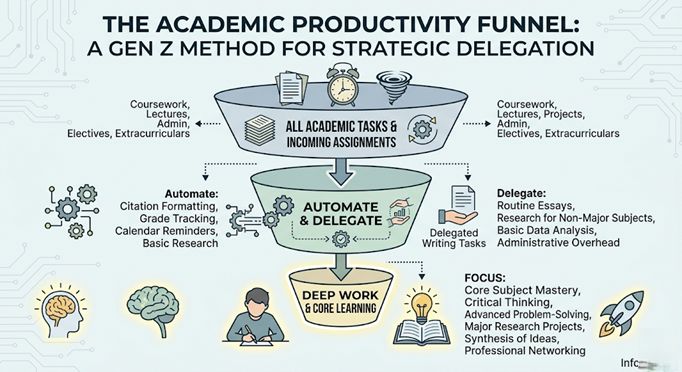
Ans: Focus on the “Low Value, High Effort” tasks. If a specific elective course isn’t relevant to your major and is taking up 80% of your time, that is a prime candidate for using academic support services. Save your own energy for the “High Value” core subjects.
Q.3. Will using a calendar really make that much of a difference?
Ans: Absolutely. Most student stress comes from the uncertainty of what is due next. Once everything is in a visual system, the “monster” becomes manageable.
Q.4. How can I make my writing sound more “human”?
Ans: Read your work out loud. If a sentence sounds too long or awkward to say in a single breath, it’s probably too “robotic.” Use transition words that reflect how people actually talk, like “However,” “On the flip side,” and “Surprisingly.
About The Author
Hello, I’m Lucy Wilson. As a senior academic consultant and content strategist, I specialize in bridging the gap between rigorous university standards and professional career readiness. With a focus on fields like Business Development and the Humanities, I develop data-driven strategies that help students navigate complex grading rubrics and improve their technical literacy.